To manage a modern commercial high-rise or a large multi-occupancy building, one must strictly comply with the complicated municipal life-safety regulations.
For property managers, security directors, and purchasing managers, dealing with fire safety compliance can soon become rather overwhelming. A frequent source of confusion is the different regulatory roles assigned to a certified Fire and Life Safety Director (FLSD) and to mobile Fire Guards.
Although both roles are important for protecting lives and property, they have completely different legal requirements, ranges of operations, and day-to-day duties.
The Strategic Leadership of a Fire and Life Safety Director
A Fire and Life Safety Director—having been previously referred to as a Fire Safety Director—is a highly qualified and certified professional who must be present in high-rise office blocks, hotels, and large commercial buildings fitted with two-way voice communication systems.
According to strict municipal regulations, for example, the New York City Fire Code, such buildings are required to have an FLSD on duty throughout regular business hours in order to supervise the property’s Comprehensive Fire Safety and Emergency Action Plan.
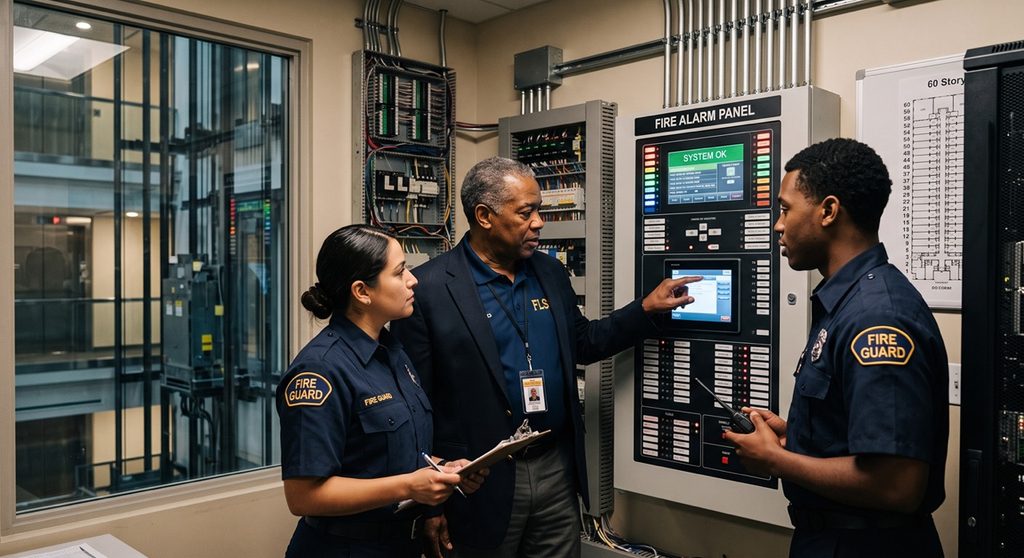
The FLSD acts as the highest on-site authority when an alarm occurs. Based at the main Fire Command Center, they look after the emergency communication systems, coordinate either the evacuation of tenants or their shelter-in-place, and act as the main point of contact for the first responders who have arrived.
Apart from emergency situations, their regular duties revolve around maintaining compliance by carrying out mandatory tenant fire drills, training the floor wardens who have been designated for this purpose, checking the logbooks, and making sure that the integrated suppression and alarm systems remain fully working.
The Tactical Vigilance of Certified Fire Guards
Although the FLSD is responsible for overall management, the Fire Guards carry out specific, mobile forms of supervision. They have the necessary certifications to carry out ‘fire watch’ duties if the building’s normal automated safety systems are compromised or if there are special hazards involved.
Municipal fire regulations require the presence of dedicated Fire Guards under certain conditions, particularly when there are planned or unplanned impairments of the system—for example, when a sprinkler valve is closed, a standpipe is being maintained, or an alarm panel is out of service.
While these systems are down, the Fire Guards carry out continuous, officially recorded patrols on a floor-by-floor basis to physically check each area for any signs of smoke, heat, or fire danger. Moreover, by law they must be present at sites where active construction or demolition is taking place to watch over hot work such as welding and torch cutting, as well as at large public events and in temporary assembly areas.
Harmonizing Roles for Complete Property Protection
It is almost never the case that achieving complete life-safety readiness comes down to one option or the other. Generally, a high-rise building makes use of an FLSD for regular structural supervision and in the event of an emergency, and at the same time employs Fire Guards on an as-needed basis when renovations, system testing, or equipment repairs temporarily increase the risk.
By understanding these operational triggers, building owners can avoid severe municipal fines, prevent expensive stop-work orders, and keep an uninterrupted shield of life safety. To maintain perfect compliance with life-safety regulations, it is necessary to have an experienced security partner who has credentialed professionals who are ready for site visits.
Doyle Security Services (DSS) offers top-quality life-safety and guarding services that are specially designed for commercial high-rise buildings, institutional complexes, and corporate head offices. Our company has a wide range of fully certified Fire and Life Safety Directors (FLSDs) who are able to manage complex emergency systems and lead regulatory drills, as well as a contingent of mobile Fire Guards who are ready to be deployed for constant 24-hour fire watches and impairment monitoring.
We assist purchasing managers and property directors in keeping to strict regulatory requirements at the same time as providing proactive protection for each occupant.
You can go to doylesecurityservices.com to speak to our compliance team and arrange for certified fire safety personnel to be assigned to your facility.