When it comes to security issues, many organizations face a dangerous gap between compliance and actual security readiness. For many business owners, security directors, and purchasing managers, meeting the annual compliance training requirement seems like a significant achievement in itself.
Offer employees an online video course, record the completion certificates, and that is it. Compliance has been satisfied, but actual preparedness has not been achieved. As a security services company with more than 20 years of experience protecting the assets, people, and reputations of some of the country’s biggest companies, Doyle Security Services (DSS) knows from direct experience that a real-world crisis does not pay any attention to compliance checklists.
In the event of an active shooter situation, superficial preparedness quickly collapses in the. chaos and confusion, which sadly often results in preventable tragedies.
The Importance of Continuous Training
True readiness for a potential crisis involves going beyond the absolute minimum by adding measures such as regular training, thorough use-of-force education, and realistic crisis drills.
Since real-world active shooter situations are high-stress, explosive, and rapidly developing events, outcomes are determined by the number of seconds involved. If an institution’s security team only goes through the incident procedures once or twice each year, then they are depending on intellectual memory rather than muscle memory. When violence is occurring and adrenaline is pumping, information from occasional training sessions will simply not spring to mind.
Continuous training, by contrast, embeds emergency procedures in a person’s subconscious so that they can carry out quick and definite actions even when under great pressure. This ongoing training must be designed to reflect the constantly evolving nature of the threats, making sure that personnel understand the best response tactics, communication procedures, and methods for navigating your facility’s geography and interacting with first responders.
Drills Reinforce Training
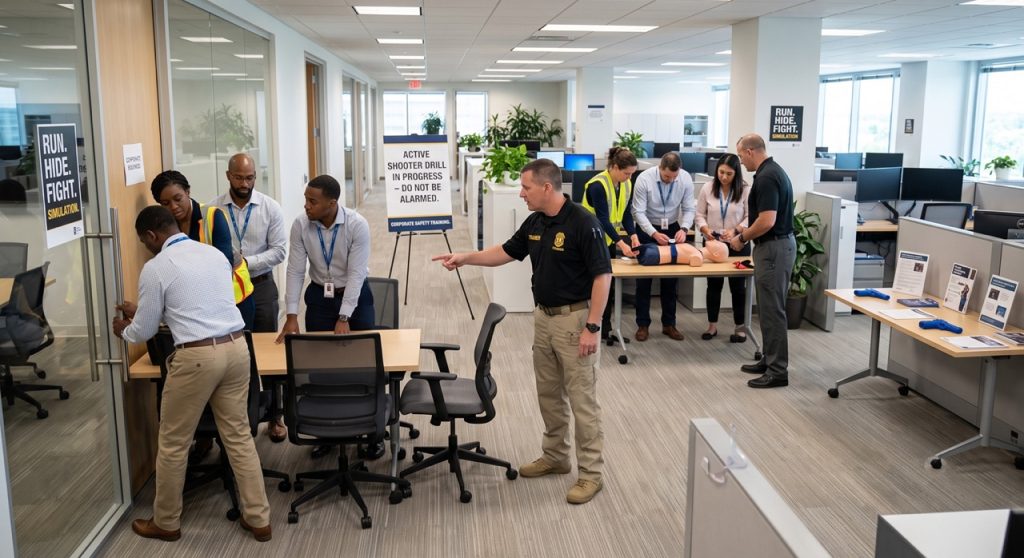
To overcome the gap between theory and practice, organizations should make it a point to carry out regular crisis drills. The drills should not merely be routine exercises that amount to a long fire drill. Instead, they have to mimic the sensory overload experienced in an actual emergency. If coordinated action is to take place, security teams must function smoothly under pressure by handling the communication channels, directing the civilians to safety, and working well with the local police who arrive.
Holding frequent drills will show any weaknesses in the security plan before an emergency occurs, highlighting communication dead spots, confusion among the chain of command, and physical bottlenecks in the evacuation routes.
When these vulnerabilities are dealt with during a controlled drill, you ensure that a stronger defense is in place when it really counts.
Securing any facility requires more than just deploying personnel; it demands a shift in mindset toward active, dynamic readiness. Security directors must look beyond the simple cost-per-hour of a guard and evaluate the depth of training that supports them. Investing in an advanced, proactive training regimen protects your most valuable assets—your employees, your visitors, and your brand reputation.
Finding the Right Partner
The team of specialists at DSS can help your organization bridge the gap between meeting basic compliance requirements and achieving a high level of real-world preparedness. Because of our many decades of experience, we offer complete and tailored active shooter training and security services to clients in a wide variety of sectors, including corporate head offices and schools, as well as healthcare facilities and retail establishments.
Our training experts can develop and deliver numerous customized workplace security sessions annually, including active shooter response, de-escalation techniques, and crisis management tabletop exercises, supporting your organization’s risk reduction goals.
Among these are our Awareness & Preparedness Training presentations. These are designed as 90-minute instructor-led sessions and include topics such as Active Shooter Response, De-Escalation, Situational Awareness, Anti-Terrorism Overview, and Fire & Life Safety. These presentations can be condensed for shorter delivery windows or expanded for more in-depth engagement if additional time is available.
DSS also offers workshop-style training sessions, which build upon the above topics with practical exercises and scenario-based drills integrated into the instruction. These engagements typically run between 2–3 hours and are designed to reinforce participant understanding through applied practice and testing methodologies.
In addition, we offer our INSIGHT-X Executive Tabletop Exercise (TTX), which can be customized to address any workplace safety or emergency preparedness scenario relevant to your organization. Each tabletop engagement spans approximately 3–4 hours and follows a progressive exercise model. For larger organizational initiatives, DSS can provide structured annualized preparedness programs that incorporate a phased “steppingstone” approach. This format allows larger clients to progressively build organizational readiness and reinforce preparedness capabilities throughout the year.
Our specialized courses equip security teams with the tactical skills, clear knowledge of how to use force, and the ability to remain resilient in various situations so that they can reduce threats and save lives.
Why not partner with DSS today to turn your security approach from a passive policy into an active and robust defense?